Home / Blog / Check AI visibility
How Do I Check My Brand's AI Visibility?
The method I use to check whether AI assistants mention and cite a brand: fixed buyer questions that never mention Reddit, several engines, and a monthly log. Includes benchmarks for a good score.
 By Oleg G.u/dashosh12 min read
Check it by asking AI engines the everyday questions your buyers ask, without naming your brand or any platform, across several engines, and log whether you are mentioned and which URLs are cited. Do it monthly with the same fixed set of questions. The average brand appears in 16.3% of relevant answers; category leaders reach 56.5%.
What Does AI Visibility Actually Mean?
It means one thing: when a real person asks an AI assistant a question that your business should answer, does your brand show up in the answer, and does the answer link to something you control or something that vouches for you? That's it. Everything else, the dashboards and the scores, is a way of counting that.
I care about this because my work sits where Reddit and AI search meet. Reddit threads are now some of the most cited pages in AI answers, so I have a direct reason to measure whether my own subreddits get cited. But the method below works for any brand, with or without Reddit, and you can run it this afternoon with a spreadsheet.
There are two separate things to count, and most tools blur them together:
- Mentions. The answer names your brand in its text.
- Citations. The answer links to a page as a source, which may be your site, a review site, a forum thread or a Wikipedia entry.
You can be mentioned and never cited, or cited and never named. They behave differently, and a brand can win one and lose the other. Track both from day one.
Sources: AthenaHQ via Business Insider, 29 September 2026; Ahrefs, September 2026.
Why Should I Check My Brand's AI Visibility At All?
Because the first screen your customer sees is increasingly written by a model. Ahrefs found that the share of branded keyword searches in US desktop Google that trigger an AI Overview climbed from 61.3% in July 2026 to 73.3% in September 2026. On 29 September 2026 the figure for that single day was 82.91%. Someone typing your brand name into Google is, most of the time, now reading a summary before they see your link.
| Month (2026) | Branded keywords | Non-branded keywords |
|---|---|---|
| July | 61.3% | 73.5% |
| August | 65.1% | 74.7% |
| September | 73.3% | 78.3% |
Source: Ahrefs, US desktop Google searches showing AI Overviews, September 2026
Look at what changed. Non-branded searches already had AI Overviews at a high rate and grew a little. Branded searches, the ones about you, grew by twelve points in two months. That's the gap closing. The searches where you thought you were safe because you own the name are now summarized by someone else.
Ahrefs also looked at what those branded summaries lean on. In a sample of 100 major brands, Wikipedia was cited in 71.9% of branded AI Overviews. Not the brands' own sites. So the model is building its picture of your company from third-party places, and if you have never looked, you don't know what that picture says.
There's also a reach question. Pew Research Center's survey, published in October 2026, found that 49% of US adults say they ever use AI chatbots like ChatGPT, Gemini or Copilot. That's half the country, but the split by age is steep:
| Age group | Ever use AI chatbots | Do not ever use |
|---|---|---|
| All US adults | 49% | 51% |
| 18 to 29 | 66% | 34% |
| 30 to 49 | 61% | 39% |
| 50 to 64 | 42% | 58% |
| 65 and over | 23% | 77% |
Source: Pew Research Center, February 2026 survey, published 9 October 2026
If your buyers are under 50, most of them already ask a chatbot things. If they're over 65, most don't. Your audience decides how much weight to give all of this. I treat it as a channel with a real but uneven reach, not as the whole market.
How Do I Check My Brand's AI Visibility Step By Step?
Here's the method I use, and it's deliberately boring. Boring is what makes the numbers comparable from one month to the next.
1. Write The Buyer Questions Once And Freeze Them
I write a set of everyday questions the way a real customer would type them, and then I don't change them. My tracker has 25 of them. They are the questions someone asks before they know who to buy from: "Peru travel tips from people who have been", "Where do Canadians talk about crypto investing?", "Ecuador travel advice from people who have been". Not "best Reddit marketing agency". Not your brand name. If you only test branded prompts you'll learn how the model describes you, which is useful, but you won't learn whether strangers find you.
2. Never Mention Reddit, Or Any Platform, In The Question
This is the rule I'm strictest about. If I type "what do Redditors say about...", of course the answer cites Reddit. I'm leading the witness. In my tracker not one of the 25 questions mentions Reddit, so when a thread from one of my subreddits turns up, the engine chose it by itself. That's the only kind of citation that tells me something.
3. Run Every Question Through More Than One Engine
Engines disagree, sometimes wildly, and I'll show you how much further down. My tracker runs each question through ChatGPT search (gpt-5.4-mini with web search) and Grok. For a bigger test you add Perplexity and Google AI Overviews. Never trust a single engine to speak for "AI".
4. Log Mentions, Citations And The Exact URLs
For each answer I record: was the brand named, was any URL of mine cited, and which URLs were cited instead. The last column is the one that pays for the whole exercise. It shows you who is winning your questions.
5. Repeat Monthly, Not Daily
Answers are not stable. Ask the same question twice and you may get different sources. A daily number mostly measures noise. A monthly log of the same fixed set, read as a trend over quarters, is where the signal is.
| Rule | What I do | Why it matters |
|---|---|---|
| Question set | 25 fixed buyer questions, written once | Month-to-month changes mean something |
| Wording | Never mentions Reddit or my brand | Engine chooses sources on its own |
| Engines | ChatGPT search and Grok in the tracker | Engines cite very different things |
| What I log | Mention, cited URL, competing URLs | Competing URLs show who to beat |
| Cadence | Monthly | Daily numbers are noise |
Source: Oleg G., byOG AI visibility tracker method, October 2026
If you'd rather not do this by hand, this is the work behind the monthly log in byOG's AI visibility service. The base program tracks 25 AI questions and logs them every month.
What Did My Own Check Find?
On 20 October 2026 I ran my 25 questions through ChatGPT search and Grok. That's 50 answers. Five of them cited a thread from one of my own subreddits: 10% of the answers.
| Engine | Question | Subreddit cited |
|---|---|---|
| ChatGPT search | Ecuador travel advice from people who have been | r/TravelEcuador |
| ChatGPT search | Where do Canadians talk about crypto investing? | r/OCryptoCanada |
| Grok | Peru travel tips from people who have been | r/GoingToPeru |
| Grok | Ecuador travel advice from people who have been | r/TravelEcuador and r/galapagostourism |
Source: Oleg G., byOG AI visibility tracker, 20 October 2026
Notice the phrasing of most of those questions. "From people who have been" is how real travelers ask, and it happens to describe what a Reddit thread is. I didn't write the question to get the citation; I wrote it because it's how people search. That's a theme I'll come back to: the questions that cite community content are the ones where the asker wants lived experience.
My takeTen percent doesn't look like much. It is also not the same measure as the benchmarks in the next section: mine counts answers citing a thread from my subreddits, theirs counts answers that mention a brand by name, so I don't put the two side by side. It's a real, small, honest baseline on questions where I never asked for Reddit, and it's the number I'll compare next month.
What Is A Good AI Visibility Score?
There's no standard scale, and anyone who sells you a "score out of 100" is using a formula you can't inspect. What you can use are published benchmarks for mention rate. AthenaHQ's report, covered by Business Insider on 29 September 2026, found the average brand is mentioned in 16.3% of relevant AI answers while category leaders appear in 56.5%.
| Mention rate in relevant AI answers | What it likely means |
|---|---|
| Under 10% | Close to invisible, below the average brand |
| 10% to 16% | Around the average brand (16.3%) |
| 17% to 35% | Above average, a recognised option in the category |
| Above 50% | Leader territory (category leaders: 56.5%) |
Source: Bands are my reading of the AthenaHQ figures (average 16.3%, leaders 56.5%), not an industry standard
Be careful with that table. The two end points are published numbers. The bands between them are my interpretation, and I'm telling you so. Treat them as a rough ruler.
There are three reasons a single percentage can mislead you:
- The question set decides everything. Ask easy branded prompts and any brand scores high. Ask category-level questions and the number falls. Compare only like with like.
- Mentions are not recommendations. A model can name you as the thing to avoid.
- Your own site is rarely the source. The same AthenaHQ study found a brand's own domain goes uncited in 84% of AI answers. Reddit alone accounted for 21.9% of off-page citations.
Source: Ahrefs, US desktop Google, September 2026
My own approach to a "good" score is simpler than any scale: it's good if it's higher than last month on the same questions, and if the sources being cited are places I can actually influence.
Which AI Engine Should I Check First?
All of them, because they behave nothing alike. This is the clearest thing my own research has shown me. On 21 October 2026 I ran the byOG AI Citation Study: 100 everyday buyer questions across 10 categories, each in two phrasings, through ChatGPT search with forced web search, Grok, Perplexity Sonar and Google AI Overviews via a live SERP check. In the neutral phrasing, which never nudges the engine toward forums, here is how often an answer cited at least one Reddit URL:
| Engine | Answers | Cited Reddit | Share |
|---|---|---|---|
| ChatGPT search | 100 | 0 | 0% |
| Grok | 100 | 3 | 3% |
| Perplexity Sonar | 100 | 31 | 31% |
| Google AI Overviews | 90 | 49 | 54.4% |
| All four engines | 390 | 83 | 21.3% |
Source: Oleg G., byOG AI Citation Study, run 21 October 2026, neutral phrasing; Google showed no AI Overview for 10 of the 100 questions
Zero for ChatGPT, over half for Google. If I had only tested ChatGPT, I'd have concluded Reddit doesn't matter in AI answers. If I had only tested Google, I'd have concluded it's everywhere. Both would be wrong, and both mistakes come from checking one engine.
The same split shows up in other people's data. Babel42 collected 8,295 AI Overviews on commercial searches between 26 September and 12 October 2026. YouTube was cited in 63.3% of them and Reddit in 24.0%. And 46% of the sites cited in Google's AI Overviews did not rank in Google's top 10 for the same search, so ranking page one is not the same as being cited.
| Site | Share of AI Overviews citing it |
|---|---|
| YouTube | 63.3% |
| 24.0% | |
| Google's own pages | 17.5% |
| NerdWallet | 10.0% |
| 9.7% |
Source: Babel42, 8,295 AI Overviews of commercial searches, 26 September to 12 October 2026
For the full engine-by-engine story, read the byOG AI Citation Study and the individual explainers on how ChatGPT uses Reddit, whether Perplexity cites Reddit and Google AI Overviews and Reddit.
Do I Need A Paid AI Visibility Tool?
Not to start. A spreadsheet, the free tier of the engines and an hour a month will tell you whether you have a problem. Paid trackers earn their price when you have hundreds of prompts, several markets or a team that needs the reporting without the manual work. Before you pay, check four things about any tool:
- Can you write your own prompts, or are you stuck with its list?
- Does it show you the raw answer and the cited URLs, not only a score?
- Does it run more than one engine, and say which model version it used?
- Can you export the history, so you can leave without losing your baseline?
The last point matters more than people think. A baseline you can't take with you is a lock-in.
Whatever you use, the method above is what makes the number meaningful. The most expensive tool with a sloppy question set will give you a worse answer than my spreadsheet with 25 frozen questions.
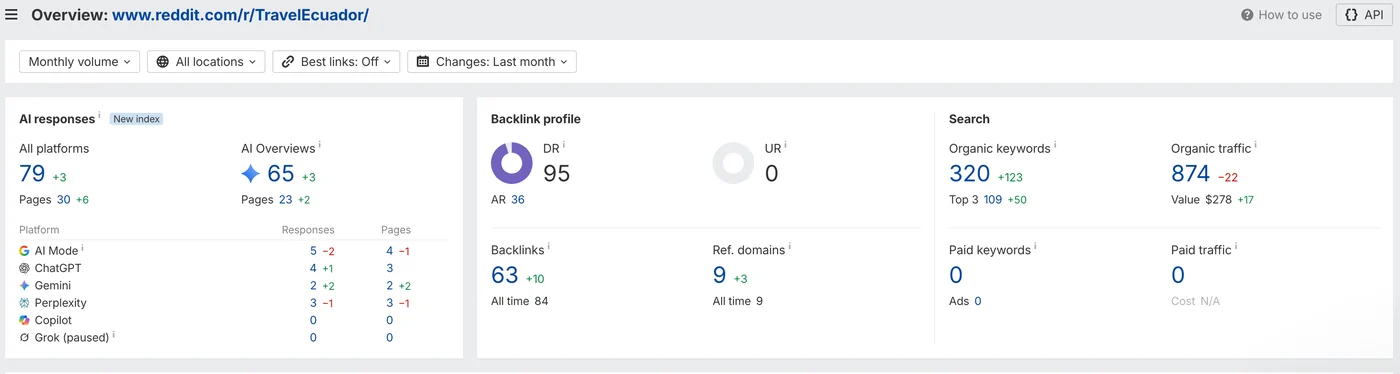
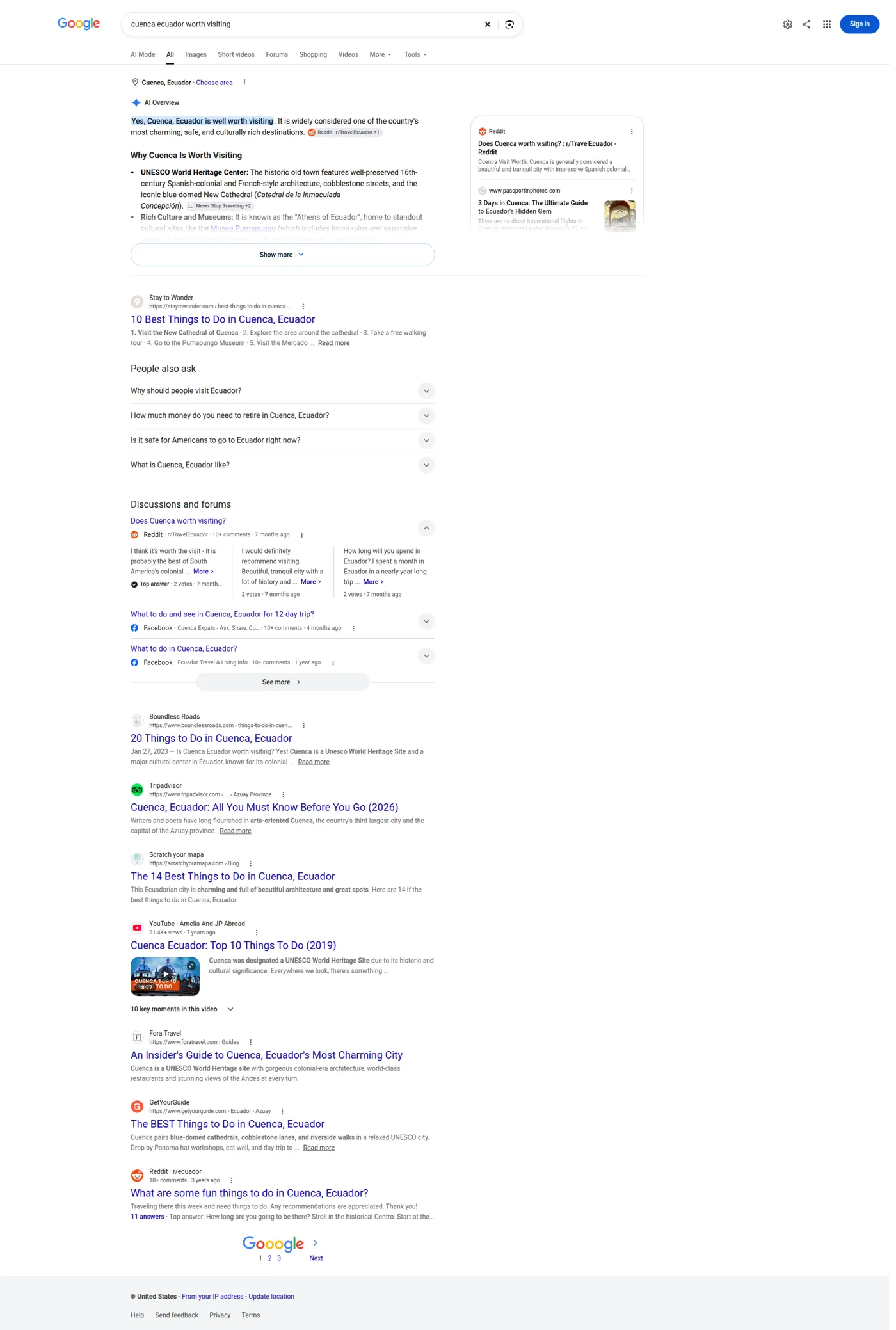
For a worked example, here is what two of those tools showed for r/TravelEcuador. Ahrefs lists 79 AI responses citing the subreddit, and 65 of them are in AI Overviews. A plain Google search then showed the same community cited in an AI Overview for "cuenca ecuador worth visiting".
What Do I Do After I Check?
Read the competing URLs column. That list is your to-do list. The cited sources usually fall into a few groups: official sites, review sites, Wikipedia-style references, video, and community threads. For each of your questions, find out which group is winning and ask whether you can have a legitimate presence there.
| Who is being cited | What it tells you | White-hat move |
|---|---|---|
| Your own site | You are the source | Keep the page current and specific |
| Review or comparison sites | Buyers want outside judgement | Earn real reviews; don't buy placements |
| Wikipedia or reference pages | The model wants a neutral summary | Make sure facts about you are public and accurate |
| YouTube | Buyers want to see it | Publish video answers to the same questions |
| Reddit threads | Buyers want lived experience | Build a real community and answer in it, openly |
Source: Oleg G., how I read an AI visibility log, October 2026
The Reddit row is the one I work on. My view is that the communities worth being cited are ones with real discussion in them, started by people who say who they are. I don't use second accounts, bought upvotes or invented customer stories, and I'd steer you away from them: they are the exact things that get a community flagged, and a flagged community is a worse source than no community. My 30-day subreddit growth playbook covers the legitimate route, and the brand subreddit service is that route done for a client.
Then you wait a month and run the same questions again. That's the loop. Measure, change one thing, measure.
Questions About Checking AI Visibility
How do I check my brand's AI visibility for free?
Write 20 to 25 everyday questions a buyer would ask, without your brand name or any platform name in them. Run each through ChatGPT, Google, Perplexity and Grok, and log whether you are mentioned and which URLs are cited. Repeat monthly with the same questions.
What is a good AI visibility score?
There is no standard scale. Published benchmarks from AthenaHQ put the average brand at 16.3% of relevant AI answers and category leaders at 56.5%. A useful goal is to beat your own number from last month on the same questions.
How often should I check AI visibility?
Monthly. AI answers change between runs, so daily numbers mostly measure noise. A fixed question set logged monthly shows a trend over a quarter.
Should my AI visibility questions mention Reddit?
No. If the question names Reddit or asks what Redditors think, the answer will cite Reddit because you asked for it. Neutral wording shows what the engine chooses by itself.